
Digitizing the content of training organizations for 4,000 companies in the graphic arts industry
How can we help training providers modernise their offering?
For training providers in the graphic arts industries, the Institut de Développement et d’Expertise du Plurimedia (IDEP), via its lalignecontinue.fr platform, commissioned the creation of virtual reality modules, available free of charge and with open access for everyone.
Training providers can use these modules freely in their training programmes, enriching learning with real-life, on-the-job style scenarios to help learners develop the right reflexes and know-how. A great example of an industry that is reinventing itself and becoming more agile by embracing digital technology.
1 – The challenge: training 4,000 companies across the sector nationwide
LaLigneContinue is a digital training platform created by the sector for the 4,000 French companies in the graphic arts industry, which employs 50,000 people. These courses may also be of interest to other segments of the graphic and visual communication industries—representing a total of 600,000 employees.
These thousands of employees are spread across the country, mainly in very small businesses (around 11 employees), where sending staff on training courses creates the challenge of keeping production running.
Testimony
2 – A collective and innovative approach
That is why IDEP has taken the lead, using new, engaging, and easily accessible methods such as virtual reality and new players such as Uptale, an immersive learning platform.
Testimony
Thus, in 2019, IDEP launched a call for educational projects aimed at training organizations to design 360° immersive experiences. These experiences are intended for professionals in the graphic industries and are made available to everyone on the platform lalignecontinue.fr.
Two training organizations, Amigraf (Lille) and NormaPrint (Montreuil), joined the initiative and co-developed around fifteen immersive training modules on the Uptale platform, with support from one of their partners for instructional design (Tips’n Learn). Four partners, together with IDEP, supported both the content and the overall structure of the project. In addition, the training organizations gained the ability to create and edit their own Virtual Reality modules independently on the platform.
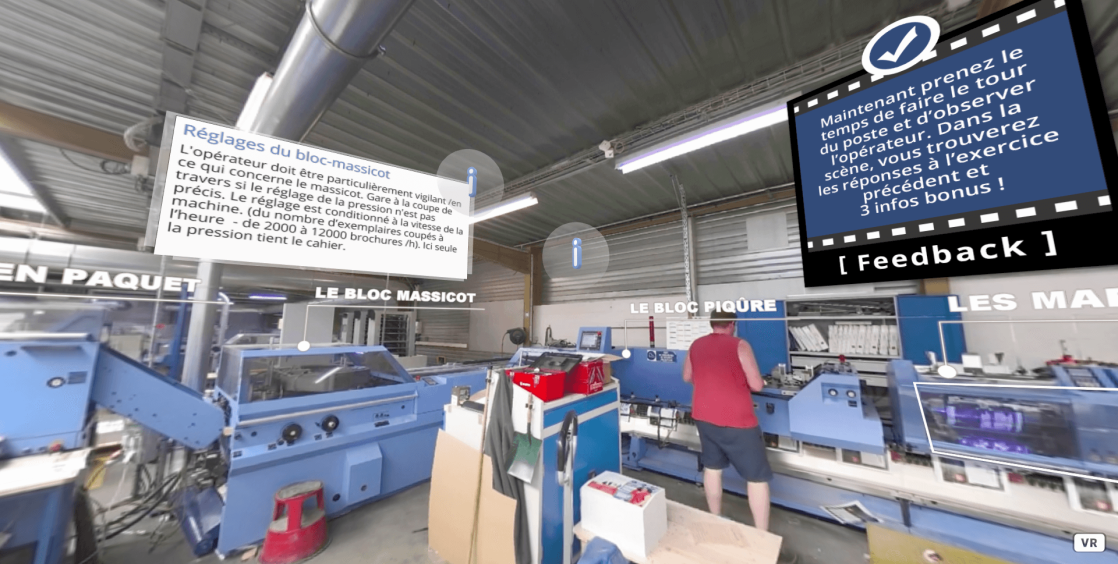
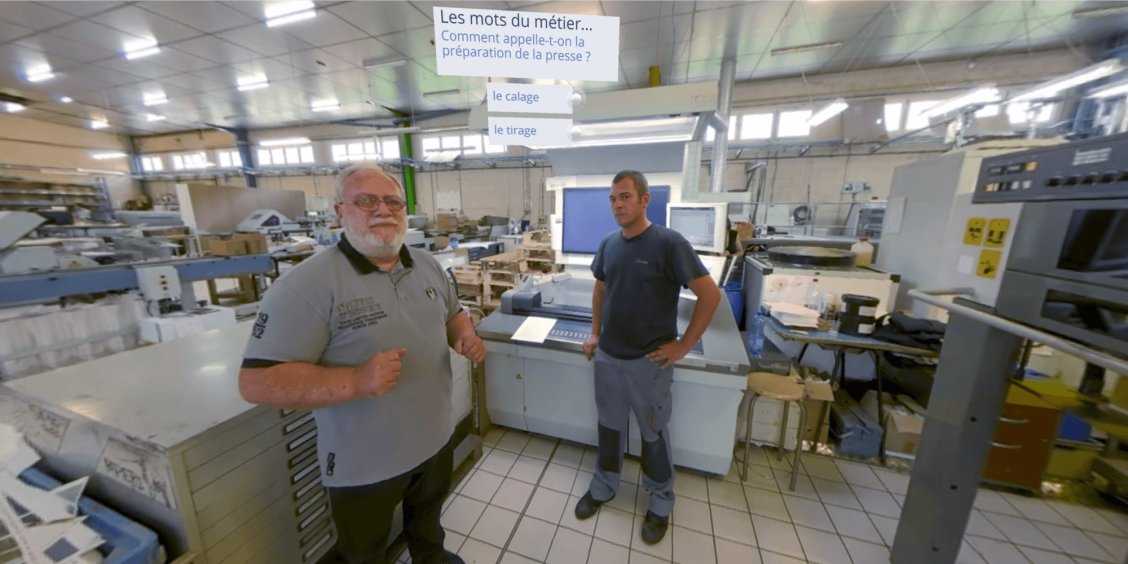
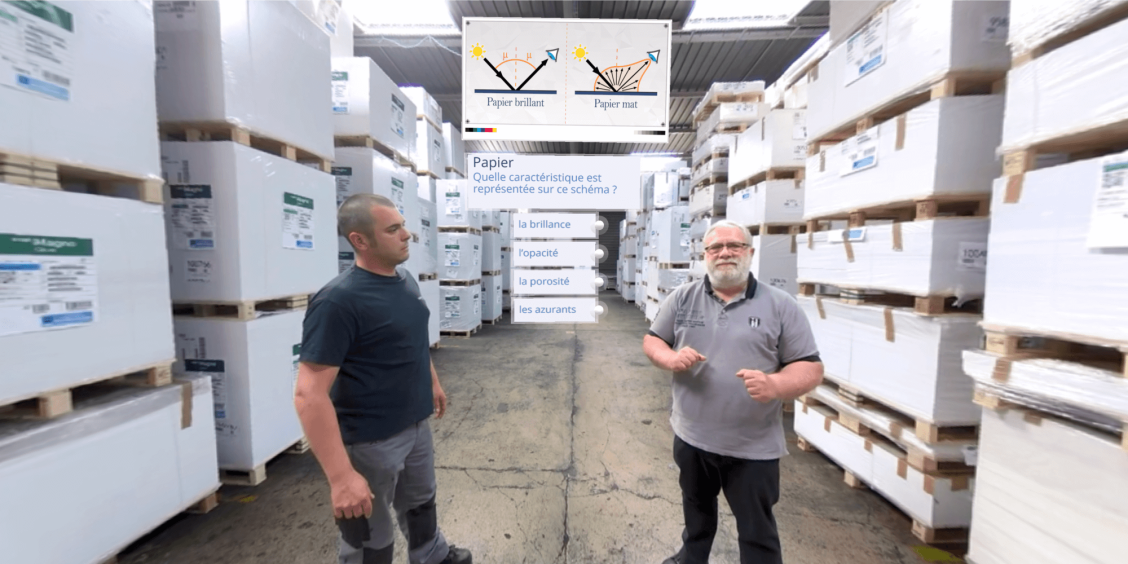
These experiences immerse learners in a 360° print shop environment and provide an introduction to key topics such as printed color management principles, printing processes, and finishing. Learners can “teleport” into the workplace, observe procedures and gestures, acquire knowledge, and most importantly, interact within the environment.
The content is accessible online to all, via computer or smartphone, or through one of the 100 virtual reality headsets distributed to enable full immersion. Today, these modules are fully integrated into hybrid training pathways offered by both training organizations.
3. Feedback and results
NormaPrint uses the VR modules as learning activities within its short courses, in guided discovery programs, or to introduce on-site technical training through blended learning formats.
See the teaser video.
“It has become an asset for selling training pathways, in addition to being an educational tool that works both remotely and as support for in-person sessions. We digitized highly technical professional situations, and that was innovative compared with simple virtual reality tours.” — Alain Delauney, President of NormaPrint
The NormaPrint team adopted the Uptale platform and planned to create new modules for 2021.
Amigraf uses these VR modules in programs leading to a Professional Qualification Certificate (CQP), for technical training.
Testimony
On IDEP’s side, many outcomes were observed one year after these modules were made available on LaLigneContinue.fr:
- A significantly higher success rate: 90% compared with 75% using traditional methods
- Near-immediate and sustained learner engagement throughout training
- The emergence of new learner behaviors: trainees are more autonomous and take more initiative
- During the first lockdown, lalignecontinue.fr recorded an activity peak with more than 1,200 views of the VR modules
- The modality is appreciated beyond any “gadget effect”
- The instructional design framework is much more precise and clearer
Thanks to this initiative led by IDEP, training organizations that cannot invest in this technology on their own can now integrate it into their training pathways. The next step is to bring more training providers on board and continue creating and distributing new immersive training modules.